Quick answer: For one bed across changing UK seasons, start with the Slumberdown Anti Allergy 3-in-1: its separate 4.5- and 9-tog layers give you three usable combinations and washable synthetic filling. Choose Snuggledown Hungarian Goose Down if you prefer down and feather, or Woolroom Deluxe Washable 3-in-1 if you specifically want wool and cotton and accept the higher outlay. If your bedroom stays fairly consistent, the single Silentnight Airmax 10.5 tog is simpler, but less adaptable.
This is a research-led comparison of construction, tog/layer options and care, not a sleep test. We have not used these duvets or independently measured warmth, breathability, comfort or durability. Your room temperature, bedding and personal warmth preference matter more than a universal “best” tog.
In this guide
- Compare the four duvets
- Choose by fill and season
- How to choose tog, size and care
- The bottom line
- Frequently asked questions
Best duvets for all seasons UK: at a glance
| Duvet | Warmth system | Why choose it | Main compromise |
|---|---|---|---|
| Slumberdown Anti Allergy 3-in-1 | Synthetic; 4.5 + 9 = 13.5 tog | Washable layers for a practical seasonal switch | Synthetic feel; “anti-allergy” is not a medical guarantee. |
| Snuggledown Hungarian Goose Down 3-in-1 | Down/feather; 4.5 + 9 = 13.5 tog | Three combinations with a traditional down-filled feel | Animal fill, care and a higher outlay. |
| Woolroom Deluxe Washable 3-in-1 | Wool layers; maker gives seasonal warmth ranges, not a fixed tog | Wool-and-cotton construction with adjustable layers | Substantial outlay and wool-specific wash/dry care. |
| Silentnight Airmax 10.5 tog | One synthetic 10.5-tog duvet | Simple choice for a fairly steady bedroom | Cannot split into lighter or warmer layers. |
The first three are layered sets; the Airmax is a single duvet, included for households that do not need to swap layers. Tog indicates thermal insulation under a standard test, not how warm you will personally feel. Woolroom describes seasonal warmth in ranges, so its figures should not be treated as identical to a conventional fixed tog.

Which all-season duvet should you choose?
Slumberdown Anti Allergy 3-in-1 — practical washable layers
Slumberdown’s model information describes synthetic filling and a washable all-seasons combination. Use the 4.5-tog layer in warmer weather, the 9-tog layer when cooler, or fasten both for 13.5 tog. It is a practical choice here if easy laundering and seasonal flexibility matter. Check that your washing machine can accommodate a double duvet; the “anti-allergy” name is not a promise that it will prevent symptoms.
- Choose: you want three warmth options and routine machine-washable care.
- Skip: you prefer natural fill or dislike storing an unused layer.
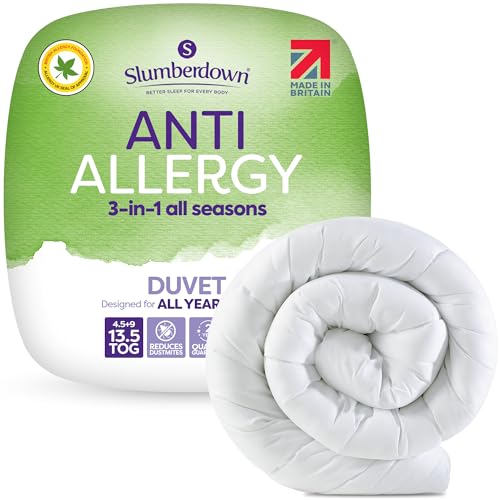
The button opens a UK double (200 × 200cm) variant. Check the offer, care instructions and returns for the size you need before ordering.
Snuggledown Hungarian Goose Down — layered natural fill
This double-size set pairs 4.5- and 9-tog duvets to make a 13.5-tog combination, with an 80% goose-down and 20% feather fill and cotton cover stated for the linked model. It offers the same three-season switching idea in a different material. Fill composition does not prove a cooler or more comfortable night; factor in care, drying space and any sensitivity to feathers.
- Choose: you want a traditional down-and-feather duvet that can be split by season.
- Skip: you avoid animal fill, need the easiest laundering or want a modest outlay.

The button opens a UK double (200 × 200cm) variant. Check the offer, care instructions and returns for the size you need before ordering.
Woolroom Deluxe Washable 3-in-1 — adjustable wool and cotton
Woolroom’s model specification describes two wool-filled layers in a cotton cover, joined for colder conditions or used separately as temperatures change. Its warmth guidance is expressed as ranges rather than a fixed conventional tog. “Washable” requires the specified wool/delicate cycle and line drying; check your machine’s capacity and the sewn-in care label. We have not tested its temperature regulation.
- Choose: you specifically want a natural wool-and-cotton layered duvet.
- Skip: you want the lowest outlay or ordinary quick tumble-dry care.

The button opens a UK double (200 × 200cm) variant. Check the offer, care instructions and returns for the size you need before ordering.
Silentnight Airmax 10.5 tog — simple one-piece alternative
The Airmax is a single 10.5-tog synthetic duvet, not a convertible all-seasons set. It may be a simpler choice for a bedroom whose temperature stays fairly steady, or for someone who would rather change bedding than store a spare duvet layer. The model name is not independent evidence that it will keep you cool in summer; a 10.5-tog duvet may be too warm in hot weather or insufficient for a cold room.
- Choose: you want one uncomplicated mid-tog duvet.
- Skip: your room changes markedly with the seasons and you need distinct lighter and warmer layers.

The button opens a UK double (200 × 200cm) variant. Check the offer, care instructions and returns for the size you need before ordering.
How to choose a duvet for changing seasons
Start with your bedroom, not the calendar: A warm room may call for a lighter layer even in winter; a cold room may need more insulation. For wide seasonal swings, two duvets that can be fastened together offer more choice than one fixed tog. If you already know you sleep warm, also compare our lighter duvet options without assuming a material alone guarantees cooling.
Compare fill and care: Synthetic, down/feather and wool differ in feel, cleaning instructions, drying time and cost. Read the exact model’s label rather than assuming every product in a fill category washes alike. Natural fill is not automatically hypoallergenic, and marketing claims about breathability do not replace trying a duvet in your own room. Our bedding-care guide covers general cleaning routines.
Check dimensions and storage: The buttons here open double 200 × 200cm versions, but other sizes may have different offers and care instructions. Measure your duvet cover and check UK bed-size guidance; duvet dimensions are not the same as mattress dimensions. A layered set also needs clean, dry storage for whichever half is not on the bed.

The bottom line
For a variable bedroom, the Slumberdown 3-in-1 is the practical washable starting point. Choose Snuggledown for down-and-feather feel, Woolroom for an adjustable wool-and-cotton build, or the one-piece Silentnight Airmax if seasonal swapping would add hassle without benefit. Match the warmth system, care and size to your own bed; none has been independently sleep-tested by us.
Frequently asked questions
Which tog combination is useful across changing seasons?
A 3-in-1 set with separate 4.5- and 9-tog layers gives lighter, medium and combined 13.5-tog options. The right layer still depends on your room and warmth preference; a single 10.5-tog duvet is simpler but less adaptable.
How does wool warmth guidance compare with tog?
Woolroom describes the separate and combined layers using seasonal warmth ranges. Treat those ranges as guidance for that wool system, not a precise conversion to a fixed synthetic or down tog.
Which fill is easiest to care for?
The washable synthetic Slumberdown set is the simplest routine-care option here if your machine can accommodate the size. Wool and down/feather models have their own wash and drying instructions; check the label for your chosen version.
How should I choose the correct duvet size?
Measure your duvet cover and check the dimensions of the particular version you plan to order. The featured buttons open double 200 × 200cm variants; other sizes may have different offers, care details and return terms.
How were these duvets compared?
We compared model construction, layer combinations, intended use and care information. We have not slept under them or independently measured comfort, warmth, breathability or durability, so personal fit and room conditions remain important.