A wooden bed frame is the best all-round choice for most bedrooms: it has a warmer look than metal, is easier to keep clean than fabric and can remain stable for years when the joints and slats are well made. Choose metal when budget, low weight or under-bed clearance matters most. Choose upholstered when a padded headboard, softer styling or lift-up storage will improve the room.
Quick Guide
- Our direct answer
- The three materials at a glance
- Six bed-frame recommendations
- Materials compared
- Match the frame to your room and mattress
- Assembly, storage and ownership
- Which bed frame should you buy?
- Frequently asked questions
Wooden vs Metal vs Upholstered Bed Frames: Our Direct Answer
Wood wins on balance. A solid wooden frame suits traditional and modern rooms, does not collect dust in the way a fabric headboard can, and is usually easier to tighten or repair than a fully upholstered base. The Vida Designs Corona is our best overall recommendation because its solid-pine construction, low foot end and useful under-bed clearance make it a practical everyday double frame rather than a purely decorative choice.
Metal offers the clearest route to a low-cost frame and often leaves the most accessible storage space underneath. Its weak point is noise: loose fasteners, thin slats and metal-to-metal contact can create movement or squeaks. Upholstered frames make a bedroom feel softer and are more comfortable to sit against, but fabric needs regular vacuuming and pale colours show marks. Ottoman versions add valuable storage, though the lift mechanism makes assembly and future moving more involved.
The Three Bed Frame Materials at a Glance
| Material | Best for | Main strength | Main compromise | Typical care |
|---|---|---|---|---|
| Wooden | Most permanent bedrooms | Warm appearance and repairable construction | Heavy; quality varies with timber and joints | Dust and retighten fixings |
| Metal | Budgets, rentals and storage clearance | Light, slim and usually affordable | Can squeak if joints loosen | Check bolts and protect finish |
| Upholstered | Comfort, softer rooms and ottoman storage | Padded headboard and broad style choice | Fabric holds dust and is harder to move | Vacuum and spot-clean carefully |
The material name does not guarantee quality. A well-braced steel frame can outlast a weak softwood frame, while a properly built upholstered base may be more stable than either. Look beyond the finish to the centre support, slat spacing, joint design and stated dimensions.

Six Bed Frame Recommendations
1. Vida Designs Corona — Best Overall Wooden Frame
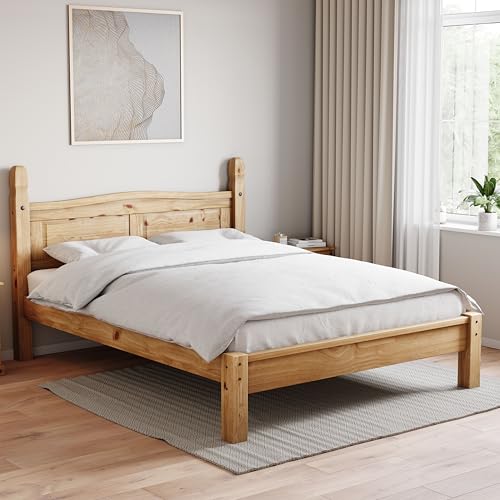
The Corona is a simple solid-pine double frame with a headboard, low foot end, reinforced wooden slats and space beneath for boxes. That combination is why it is our default recommendation. The low foot end keeps the sight line open in an average UK bedroom, while the 148.4cm overall width leaves enough margin around a standard 135 × 190cm double mattress for the side rails.
Pine is softer than oak or rubberwood, so it will show dents and surface wear more readily. The trade-off is a more accessible price band and a frame that still feels like furniture rather than a temporary base. The rustic finish is distinctive; anyone wanting a cleaner contemporary look should choose the Banham or the upholstered Zinus Piper.
- Best for: a main or guest bedroom needing versatile solid wood.
- Useful detail: low foot end and accessible under-bed storage.
- Check first: the rustic finish and 206.4cm overall length suit the room.
2. Reinforced Beds Banham — Best Premium Wooden Frame
The Banham is the wooden option for buyers who care more about structure than decorative extras. It uses solid rubberwood, a restrained Shaker-style headboard and 28mm slats. Rubberwood is dense and stable, while the thicker slats are a more meaningful specification than a vague promise of “heavy duty”. A five-year manufacturer guarantee adds reassurance, although the terms should be checked before purchase.
This frame costs more and lacks built-in storage. It also needs enough access for assembly because a solid double frame is not something you want to build in the hall and then discover will not turn through the bedroom door. Choose it for a long-term main bedroom, not as the cheapest way to get a mattress off the floor.
- Best for: buyers prioritising a robust, understated wooden frame.
- Useful detail: thick slats and a five-year stated guarantee.
- Check first: current stock is limited and the frame has no integrated storage.

3. Zinus Geraldine — Best Budget Metal Frame
The Geraldine makes the strongest case for metal: it is slim, inexpensive, visually light and leaves around 28cm of clearance underneath. The integrated steel slats mean there is no separate wooden slat pack to bow or split, and the pipe-style headboard and footboard are plain enough to work in a rented room, teenager’s bedroom or compact guest room.
Zinus states a load capacity up to 320kg and includes a five-year limited warranty, but those figures do not remove the need for correct assembly. Tighten fixings evenly, fit every support point and recheck them after the first few weeks. A metal frame that starts square and stays tight is far less likely to become noisy.
- Best for: budget buyers and rooms needing open storage below.
- Useful detail: steel slats and a simple black finish.
- Check first: the mattress maker permits a metal slatted platform.

4. Yaheetech Vintage — Best Decorative Metal Frame
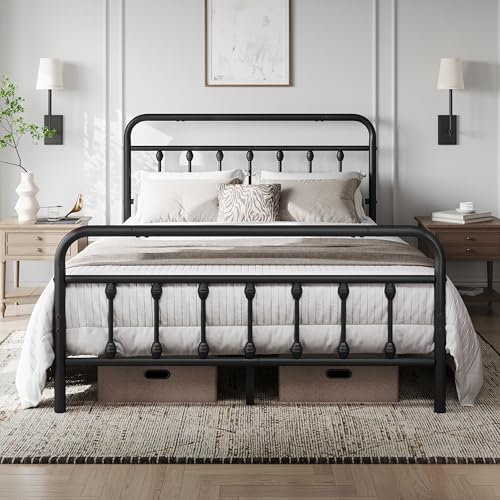
Yaheetech’s vintage frame is for buyers who like the practicality of metal but find minimalist black rectangles a little bleak. The curved headboard and footboard soften the industrial feel, while 12 metal slats form the mattress platform. Its 32cm open under-bed area is the largest stated clearance in this shortlist, useful for suitcases and lidded storage boxes.
The high footboard can make a small room look busier and may annoy taller sleepers who prefer their feet unobstructed. Decorative curves also create more edges to dust. Neither issue is fatal; they simply mean this is a style-led alternative to the Geraldine rather than an automatic upgrade.
- Best for: traditional or vintage-inspired rooms on a modest budget.
- Useful detail: 32cm open clearance beneath the platform.
- Check first: high footboard, overall dimensions and mattress support rules.
5. Zinus Piper — Best Upholstered Frame
The Piper provides the main reason to choose upholstery without making the design fussy: its off-white padded headboard is comfortable to sit against, while the horizontal panels keep the shape simple. Under the fabric, a steel structure and wooden slats support a standard UK double mattress. The components arrive in one box, which helps with delivery through tighter hallways.
Off-white fabric needs more care than wood or powder-coated metal. Dust it with an upholstery attachment and deal with spills according to the care instructions rather than soaking the surface. The low-profile look suits modern rooms, but households with pets, young children or heavy make-up use may prefer a darker fabric or a wipe-clean frame.
- Best for: a softer bedroom with a comfortable reading headboard.
- Useful detail: steel inner structure with wooden mattress slats.
- Check first: pale upholstery requires regular care.

6. Vida Designs Veronica — Best Upholstered Storage Frame
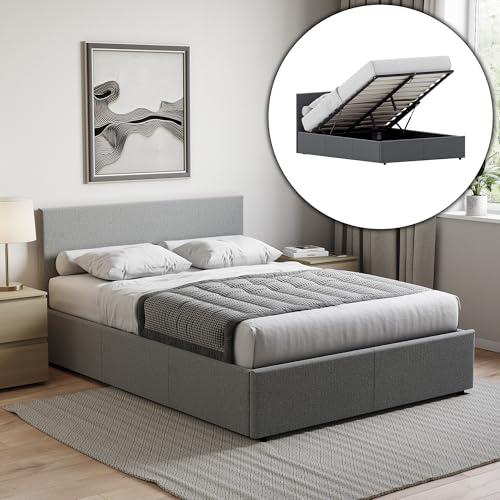
The Veronica earns its place because the whole mattress platform lifts to reveal storage. In a bedroom without room for deep drawers, that is more useful than open clearance beneath a conventional frame: bedding, spare pillows and seasonal clothes can be hidden without adding another cupboard. The light-grey linen finish and padded headboard keep it visually softer than a wooden ottoman base.
Gas-lift storage introduces moving parts and a heavier platform. Build it in the room where it will stay, follow the lifting instructions and keep hands clear of hinges. Stored items must not obstruct the mechanism or press against the mattress base. If you move frequently, the simpler Piper or Geraldine is easier to dismantle and carry.
- Best for: bedrooms short on enclosed storage.
- Useful detail: full-width lift-up compartment beneath the mattress.
- Check first: assembly space, lifting clearance and mechanism instructions.
Wooden, Metal and Upholstered Frames Compared
Durability and repair
Solid wood has the clearest repair path. Screws can be retightened, small marks can be refinished and individual slats are often replaceable. Engineered-wood components are less forgiving when fixings tear out. Metal does not split, but a bent tube, cracked weld or stripped thread is harder to fix neatly at home. Upholstered frames hide their structure, so assess the underlying timber or steel rather than judging only the fabric.
Noise and movement
No material is automatically silent. Creaks usually come from movement at joints, slats or the centre rail. Wooden frames can develop friction where timber parts meet; metal frames can click where bolts or tubes move; upholstered frames may hide the source. Assemble on a level floor, use every washer and support leg, and tighten progressively rather than fully locking one corner first.
Cleaning and dust
Wood and metal are easiest to wipe. Upholstery needs vacuuming around seams and buttons, and fabric can retain pet hair or dust. That does not make an upholstered frame unsuitable for everyone with allergies, but it adds another textile surface to maintain. Hot sleepers should also think about the whole bed rather than the frame alone; breathable bed sheets for warmer nights will affect comfort more directly than whether the side rail is wood or fabric.
Match the Frame to Your Room and Mattress
Measure the complete frame
A UK double mattress is normally 135 × 190cm, but the frame is wider and longer. Headboard depth, side rails, footboards and upholstery can add several centimetres. Mark the full external footprint on the floor, then check drawer openings, wardrobe doors and the route from the front door to the bedroom. Our detailed guide to choosing a bed frame covers the room-planning stage.
Check slat spacing and centre support
Read the mattress warranty before choosing a base. Foam and hybrid mattresses often require closer slat spacing than traditional sprung models, and a double frame normally needs a centre rail or central support legs. A visually attractive frame with wide gaps can undermine the mattress above it. Our explanation of mattress foundation types shows how slats, platforms and divans change support.
Adjustable beds are a separate category. Their moving platform needs a compatible surround or dedicated frame; a standard fixed slatted bed is not interchangeable. If elevation features are the priority, read whether smart adjustable beds are worth it before buying a conventional frame.
Assembly, Storage and Long-Term Ownership
Assemble it square
- Sort the parts: identify rails, slats, fittings and left/right components before lifting anything.
- Build loosely: connect the main rectangle without fully tightening one corner.
- Check alignment: confirm the diagonals, centre rail and support feet sit correctly.
- Tighten in stages: work around the frame so tension is distributed evenly.
- Recheck later: inspect fixings after the first few weeks and after moving the bed.
Two people make assembly safer and reduce the chance of twisting a long side rail. Protect the floor, keep children away from loose fittings and never improvise missing structural parts. For an ottoman, follow the order for fitting gas struts; they are under load and should not be treated like ordinary hinges.
Storage changes the decision
Open clearance is cheapest and easiest to access, but boxes remain visible and collect dust. Drawers need clear floor space beside the bed. Ottoman storage uses the full footprint and works well in narrow rooms, though the lifting platform is heavier. Do not buy storage you will barely use: simpler frames have fewer parts to loosen and are easier to move.
If you choose upholstery, look for permanent labels and retailer information relevant to the UK’s Furniture and Furnishings (Fire) (Safety) Regulations. Coverage depends on the product and component, so ask the retailer rather than assuming a decorative fabric label answers every safety question.
Finish the room around sleep rather than the bed frame alone. Warm, controllable bedroom lighting is a more useful upgrade than paying extra for LEDs built into a headboard. Independent guidance from the National Bed Federation’s Bed Advice UK is also useful when comparing bed sizes, mattresses and bases.
Which Bed Frame Should You Buy?
Buy wood for the best balance of appearance, maintenance and long-term ownership. The Vida Designs Corona is our value-led overall choice; the Banham is the stronger premium option when thicker slats and solid rubberwood justify the extra spend.
Buy metal when the budget is tight, you expect to move, or you want the most open space beneath the bed. The Zinus Geraldine is the cleaner, simpler design; Yaheetech suits a more decorative room. Buy upholstered for a padded headboard or enclosed storage. The Zinus Piper keeps that choice simple, while the Veronica ottoman earns its extra complexity in a room where storage is scarce.
The biggest mistake is choosing by finish before checking structure. Confirm the external dimensions, mattress compatibility, slat spacing, centre support and route into the room. Once those pass, material becomes a question of style and maintenance rather than a gamble on whether the bed will work.
Frequently Asked Questions
Which bed-frame material lasts the longest?
A well-made solid-wood frame is usually the easiest to maintain and repair over many years. Heavy steel can also last, but welds and threads are harder to repair. Construction quality matters more than the material label alone.
Are metal bed frames more likely to squeak?
They can squeak when fixings loosen or metal parts move against each other, but a correctly assembled frame on a level floor may remain quiet. Tighten bolts progressively and recheck them after the frame settles.
Are upholstered beds difficult to keep clean?
They need more maintenance than wood or metal. Vacuum seams and the headboard regularly, follow the care label for spots and avoid soaking the fabric. Darker, tightly woven upholstery is more forgiving in busy homes.
Can any mattress go on any bed frame?
No. Check the mattress maker’s requirements for slat spacing, platform ventilation and centre support. Using an unsuitable base can affect comfort, mattress condition and warranty coverage.
Is an ottoman bed worth it?
Yes when enclosed storage is limited and you will use the compartment regularly. It is less attractive for frequent movers because the frame is heavier, assembly is more involved and the gas-lift mechanism adds moving parts.
What size frame fits a UK double mattress?
The mattress is normally 135 × 190cm, but the frame’s external footprint is larger. Always use the product’s overall width, length and headboard height when measuring the bedroom.