The Millie & Boo 22 Momme is the best silk pillowcase for most UK buyers in this comparison. Its 50 × 75cm size fits a standard UK pillow, the zip keeps the case in place and 22 momme offers a sensible balance between the lighter feel of 19 momme silk and the higher cost of 25 momme.
That does not make it the right choice for everyone. Jasmine Silk’s 19 momme case is the better first purchase, Fishers Finery is the premium 25 momme option, and the Vespersilk set makes more sense as a gift. The comparison below separates fabric weight, size and closure so you can choose from measurable differences rather than beauty claims.
In This Article
- Our direct answer
- Silk pillowcases at a glance
- Six recommendations
- How to choose
- Silk vs satin
- Hair and skin claims
- Washing and care
- Final verdict
- Frequently asked questions
Best Silk Pillowcase UK: Our Direct Answer
Choose the Millie & Boo if you want the most balanced specification: 22 momme silk, a standard UK size and a zip. It is neither the cheapest nor the heaviest, and that is the point. The specification suits someone buying one case for nightly use without paying a large premium for 25 momme fabric.
Choose Jasmine Silk 19 Momme if value matters most. Its envelope closure is simple, the dimensions are right for common UK pillows and the lighter fabric lets you try silk at a lower cost. Choose Fishers Finery only after measuring your pillow: its 25 momme fabric is the premium option, but its roughly 51 × 71cm standard size is shorter than the usual UK case.
The biggest buying mistake is treating “Grade 6A”, “organic” or “anti-ageing” as substitutes for basic specifications. Look first for fibre composition, momme, usable dimensions, silk on one or both sides, closure and care instructions. If those are unclear, the grander claims do not rescue the product.
The Best Silk Pillowcases at a Glance
Start with the row that matches your priority. The table is deliberately free of shopping buttons so you can compare the six exact variants before opening a retailer page.
| Pillowcase | Our award | Momme | Selected size | Closure |
|---|---|---|---|---|
| Millie & Boo 22 Momme | Best overall | 22 momme | 50 × 75cm | Zip |
| Jasmine Silk 19 Momme | Best budget | 19 momme | 50 × 75cm | Envelope |
| Fishers Finery 25 Momme | Best premium | 25 momme | Approx. 51 × 71cm | Offset envelope |
| Jasmine Silk 22 Momme | Best envelope closure | 22 momme | 50 × 75cm | Envelope |
| ZIMASILK Grade 6A | Best zip upgrade | Momme not stated | 50 × 75cm | YKK zip |
| Vespersilk Pillowcase & Eye Mask | Best gift set | 19 momme | 50 × 75cm | Hidden zip |
Momme measures silk fabric weight, not softness, fibre grade or medical benefit. A higher figure means more silk by weight across a set fabric area, but weave, finishing, seams and washing still affect how a case feels and wears.
Our Six Silk Pillowcase Recommendations
1. Millie & Boo 22 Momme — Best Overall
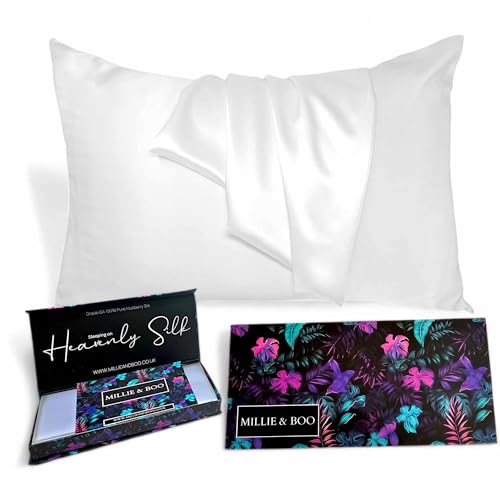
The Millie & Boo is the strongest all-round choice because it combines a useful 22 momme weight with a familiar UK 50 × 75cm size and a zip closure. That specification sits in the sensible middle: more substantial than most 19 momme entry-level cases, but without the cost and extra density of a 25 momme premium model.
The exact white variant is described as mulberry silk on the product page and comes in a gift box. The zip keeps the pillow tucked inside, which is helpful if an envelope case tends to work loose overnight. The trade-off is that a zip adds hardware to something your face rests against, so turn the pull away from your usual sleeping side and check it closes smoothly before washing.
Claims such as “organic”, “Grade 6A” and anti-wrinkle benefits are not reasons to buy on their own. The listing data does not supply a traceable organic certificate, and fibre grade does not replace useful information about momme, dimensions and care. Buy this for its balanced construction and practical size, not for promises that a pillowcase can transform skin.
- Buy it if: you want a 22 momme case, UK standard dimensions and a secure zip.
- Skip it if: you dislike zips or want the densest silk in the shortlist.
- Main compromise: some prominent marketing claims are harder to verify than the basic specification.
2. Jasmine Silk 19 Momme — Best Budget

Jasmine Silk’s 19 momme case is the sensible starting point if you want real silk without paying for a heavier fabric. The selected ivory version measures 50 × 75cm and uses an envelope closure. Both details are refreshingly ordinary: it fits a standard UK pillow and has no zip to catch during washing or press against your face.
Nineteen momme is not automatically flimsy. It simply uses less silk by weight than a 22 or 25 momme fabric of the same area. That usually means a lighter feel and a lower purchase cost, while care technique has a large influence on how long it remains presentable. Follow the stated 30°C wash guidance, use a mild silk detergent and air dry it away from direct heat.
This is the one we would choose for a first silk pillowcase or a guest room. Move up to the 22 momme Jasmine only if you already know you prefer a slightly more substantial fabric. Ignore the listing’s eczema, anti-ageing and moisture language; it is bedding, not a treatment.
- Buy it if: you want a simple, lower-cost 19 momme case in a standard UK size.
- Skip it if: you want a zip or a denser premium fabric.
- Main compromise: lighter silk may show wear sooner if washed harshly.
3. Fishers Finery 25 Momme — Best Premium

Fishers Finery is the premium choice for buyers who specifically want a denser 25 momme fabric. The selected standard size is approximately 51 × 71cm, so it is shorter than a typical 50 × 75cm UK pillowcase. Measure the pillow itself before ordering rather than assuming the word “standard” means the same thing in every market.
The case uses silk on both sides and an offset side entry with an oversized envelope flap. That avoids a zip while doing more to retain the pillow than a shallow open envelope. The product information also names OEKO-TEX STANDARD 100 and MADE IN GREEN claims. These relate to harmful-substance testing and supply-chain criteria; they do not prove that the case will improve acne, wrinkles or sleep temperature.
Twenty-five momme makes sense when you value a heavier hand and expect to use the case nightly. It is poor value if you are only curious about silk or regularly lose pillowcases to hot tumble drying. The unusual UK fit is the decisive drawback, not the price alone.
- Buy it if: you want a heavier 25 momme case and the dimensions suit your pillow.
- Skip it if: you need a full 75cm UK-standard length.
- Main compromise: premium fabric with a less familiar standard-size measurement.
4. Jasmine Silk 22 Momme — Best Envelope Closure

This 22 momme Jasmine Silk case is the best alternative to our overall pick if you want the same middle-weight logic without a zip. It measures 50 × 75cm, uses an envelope closure and is described as mulberry charmeuse silk. Charmeuse describes the weave and finish; it is not a separate fibre from silk.
The main decision is between this and the cheaper 19 momme version. Both use the same practical size and care guidance, while the 22 momme case has more silk by weight for the same fabric area. That can feel more substantial, but it does not make the case three momme “softer”, nor does it guarantee longer life if it is washed with enzymes, bleach or excessive heat.
Choose it if loose zip pulls annoy you or you tend to sleep close to the case edge. Choose Millie & Boo if pillow retention matters more. As with the 19 momme model, the useful evidence is construction and care; the broad skin claims should not be treated as medical evidence.
- Buy it if: you want 22 momme silk with no zip and a true 50 × 75cm size.
- Skip it if: your pillow regularly escapes envelope cases.
- Main compromise: the closure is simpler but less secure than a zip.
5. ZIMASILK Grade 6A — Best Zip Upgrade

The ZIMASILK is the shortlist’s zip-focused upgrade. Its exact ivory variant is 50 × 75cm, uses silk on both sides and specifies a hidden YKK zip with reinforced seams. That named zip is more meaningful than vague claims about luxury because it identifies the component responsible for keeping the pillow enclosed.
There is one important omission: the current product information does not state the momme weight. Do not infer it from “Grade 6A”, because fibre grade and fabric weight are different measurements. The product also states OEKO-TEX certification, but buyers who care about a specific certificate should confirm the label or certificate number supplied with the exact variant.
This is a reasonable choice when closure quality ranks above fabric-weight comparison. It is not the one to buy if momme is your main decision criterion, because the other five recommendations give a stated weight.
- Buy it if: you prioritise a named hidden zip and reinforced seams.
- Skip it if: you will not buy without a stated momme weight.
- Main compromise: better closure detail but weaker fabric-weight transparency.
6. Vespersilk Pillowcase & Eye Mask — Best Gift Set

Vespersilk is the easiest gift choice because the set includes a 19 momme, 50 × 75cm pillowcase and a matching eye mask. The pillowcase is described as silk on both sides with a hidden zip, while the mask has silk surfaces and a cotton-padded interior.
The set format is its reason to exist in this comparison. If the recipient only wants a pillowcase, the 19 momme Jasmine is the cleaner budget purchase. If they use eye masks, this avoids buying two separate products and gives the present a more complete feel.
As elsewhere, treat “organic”, anti-ageing and hair-repair language as seller claims rather than established outcomes. The relevant buying facts are the included pieces, dimensions, 19 momme specification and hidden closure. Confirm the current guarantee conditions before relying on them.
- Buy it if: you want a coordinated pillowcase and eye-mask present.
- Skip it if: the eye mask will sit unused in a drawer.
- Main compromise: you are paying for the set rather than a heavier pillowcase.
How to Choose a Silk Pillowcase
Start with Fibre and Sidedness
Silk should be named as the fibre. “Silky”, “silk feel” and “satin” do not prove silk content. Check whether the product uses silk on both sleeping surfaces or combines a silk face with cotton underneath. A one-sided case can be sensible for budget control, but it should not be compared directly with a two-sided silk case.
Compare Momme, Not Thread Count
Thread count is a poor shortcut for silk. Momme is the more relevant weight measurement. Nineteen momme suits cost-conscious buyers; 22 momme is the everyday sweet spot; 25 momme is for someone who deliberately wants denser fabric. Do not assume the highest number is automatically coolest or softest.
Measure the Pillow
A UK standard pillowcase is commonly sold around 50 × 75cm, but “standard” varies by market. Measure the filled pillow from seam to seam. An over-tight case can compress the pillow and strain seams; an oversized one can crease and bunch beneath your face. Our guide to replacing pillows can help if the insert itself has lost support.
Choose Envelope or Zip
An envelope has no hardware and is easy to wash, but a shallow flap may release the pillow. A concealed zip holds it more securely, though the pull and stitching add potential wear points. Neither is universally better. Restless sleepers may appreciate a zip; anyone sensitive to small hard details may prefer an envelope.
Silk vs Satin: What Is the Difference?
Silk is a fibre. Satin is a weave with a smooth face, and it can be made from polyester, silk or another fibre. That is why a polyester satin pillowcase can look glossy and feel slippery while costing much less than mulberry silk.
Choose polyester satin when the goal is a low-cost smooth surface and easy care. Choose silk when you specifically value the natural fibre, lower static tendency and distinctive feel enough to accept delicate washing. Neither material should be sold as a treatment. If overheating is the main problem, compare the whole bedding system in our guides to sheets for hot sleepers and summer cooling sheets.
Hair and Skin Claims: What the Evidence Can Support
A smooth surface can create less drag than a rough one, so some people notice less tangling, frizz or disruption to a styled curl pattern. That is a plausible comfort and grooming benefit, not proof that silk repairs damaged hair or prevents split ends. Hair products, moisture, style, movement and the condition of the fabric all affect the result.
Skin claims need stronger caution. A pillowcase cannot diagnose or treat acne, eczema, rosacea or wrinkles. A small published clinical study compared silk-like bedding with cotton for facial acne, but limited evidence of that kind does not establish that every retail silk case will prevent breakouts. The British Association of Dermatologists’ eczema guidance focuses on recognised care and treatment rather than miracle bedding.
Cleanliness matters whatever the fibre. Rotate and wash cases regularly, especially after sweating or when hair and skin products transfer to the fabric. See our practical guide to how often to wash bedding. Seek professional advice for persistent irritation rather than repeatedly changing pillowcase brands.

How to Wash and Care for Silk
Follow the Exact Label
Do not assume every silk case has identical instructions. Some permit a 30°C delicate machine wash; others prefer hand washing. Close zips, turn the case inside out and use a mesh bag when the label allows machine washing. Wash pale and dark colours separately, particularly for the first few cycles.
Use Silk-Safe Detergent
Use a small amount of detergent designed for silk or delicates. Avoid bleach and biological products containing enzymes intended to attack protein stains, because silk itself is a protein fibre. Fabric conditioner can leave residue and is unnecessary for creating softness.
Air Dry Without High Heat
Gently reshape the case and air dry it away from radiators and strong direct sunlight. Do not wring it. If the label permits ironing, use a cool setting while the fabric is slightly damp. Keeping two cases in rotation is often more useful than buying one expensive case and forcing it through a quick hot wash every few days. Our organic cotton and regular cotton comparison explains why fibre labels and certification scope also matter elsewhere in bedding.
Which Silk Pillowcase Should You Buy?
Buy the Millie & Boo 22 Momme if you want the best balance of weight, UK sizing and pillow retention. Buy Jasmine Silk 19 Momme if this is your first silk case or the budget matters most. The 22 momme Jasmine is the better no-zip option, while Fishers Finery is for buyers who want a heavier case and have checked its shorter dimensions.
ZIMASILK makes sense when a named hidden zip matters more than a published momme figure. Vespersilk is the gift pick because it includes an eye mask. Whichever one you choose, buy on dimensions, construction and care—not the promise that one night on silk will solve a medical or cosmetic concern.
Frequently Asked Questions
What is the best silk pillowcase in the UK? The Millie & Boo 22 Momme is the best overall choice in this shortlist because it balances a useful fabric weight, standard 50 × 75cm UK sizing and a secure zip. Choose a different model when budget, closure style or a heavier 25 momme fabric matters more.
What momme weight is best for a silk pillowcase? Nineteen to 22 momme is a practical range for most buyers. Nineteen momme is lighter and usually cheaper, 22 momme offers a balanced everyday weight, and 25 momme feels denser but costs more.
Is silk better than satin for a pillowcase? Silk is a fibre, while satin is a weave that can be made from polyester, silk or other fibres. A polyester satin case can provide a smooth surface for less money, but it does not have the same fibre composition or care requirements as silk.
Do silk pillowcases prevent wrinkles and acne? A smooth case may create less friction than a rough fabric, but a silk pillowcase is not a proven treatment for wrinkles or acne. Persistent skin concerns should be discussed with a qualified healthcare professional.
How should you wash a silk pillowcase? Follow the exact care label. Many silk cases permit a cool delicate wash with a silk-safe detergent, ideally inside a mesh bag. Avoid bleach, biological detergents and high heat, then air dry away from direct sunlight.
How often should you replace a silk pillowcase? There is no fixed replacement date. Replace it when seams fail, the fabric thins, stains remain after suitable washing or the closure no longer works. Gentle washing and rotation between two cases can reduce wear.