Most mattresses do not fail overnight. They slowly become less supportive, less comfortable and harder to keep fresh, so you adapt without noticing. If you are looking for signs need new mattress, start with the boring evidence: how you sleep, how your body feels in the morning, and what the mattress looks like when the bedding is off.
In This Article
- Signs Need New Mattress: The Quick Decision Test
- Comfort and Support Signs You Feel in the Morning
- Visible Wear: Sagging, Lumps and Noisy Springs
- Sleep Quality, Allergies and Heat Build-Up
- Mattress Age, Warranty and What UK Retailers Actually Mean
- What to Check Before You Buy a Replacement
- Frequently Asked Questions
Signs Need New Mattress: The Quick Decision Test
A mattress is probably due for replacement when several small problems line up. One bad night’s sleep is not enough. A visible dip alone is not always enough either, especially on an older spare-room mattress that nobody uses. The useful test is whether the mattress is now making sleep worse and whether simple fixes have failed.
Start with three questions:
- Do you wake up uncomfortable more often than not? Stiff hips, sore shoulders or lower-back tightness can point to poor support.
- Can you see or feel permanent damage? Sagging, ridges, lumps, broken springs and soft edges are not normal ageing quirks.
- Has the mattress stopped matching your life? Weight changes, a new partner, pregnancy, injury or moving from slats to a different base can all expose an old mattress.
The aim is not to scare you into buying a new bed. A mattress is expensive, awkward to return and annoying to dispose of. It is worth checking whether a topper, better base or simple rotation would solve the problem first. Our guide to whether mattress toppers actually help is useful if the mattress is still flat and supportive but feels too firm.
Sign 1: You sleep better away from home
This is the clearest everyday clue. If you consistently sleep better in a hotel, at a relative’s house or on a newer spare bed, your own mattress deserves suspicion. One good hotel night could be clean sheets, blackout curtains or being away from work email. A pattern is different.
We see this most often with older memory foam and cheap open-coil mattresses. They still look presentable with bedding on, but they no longer give even support. You spend the night shifting around, then wake up assuming you are stressed or getting older. Sometimes you are. Sometimes the bed is just tired.
Do a two-week note on your phone. Rate your sleep out of 10, note any aches, and add where you slept. If your own mattress keeps scoring lower than other beds, that is useful evidence.
Comfort and Support Signs You Feel in the Morning
The body usually notices mattress failure before the eye does. Support changes slowly, so the signs are easy to explain away: bad posture, too much driving, a hard gym session, sitting at a laptop. Those may be part of it, but a mattress that no longer holds you evenly can make normal stiffness worse.
Sign 2: You wake with new aches that ease after moving
Morning stiffness that improves once you walk around can mean your sleeping position is being pushed out of alignment. Side sleepers often feel it in the shoulder and hip. Back sleepers may notice the lower back. Front sleepers can wake with neck and rib discomfort if the mattress has softened too much around the chest and hips.
This is not a medical diagnosis. Back pain has many causes, and the NHS back pain guidance is the better starting point if pain is severe, persistent, spreading down the leg or linked with other symptoms. For normal mattress checks, look for timing: do you feel worse after sleeping, then better after getting moving?
Try two checks before buying:
- Rotate the mattress if the care label allows it, then sleep on it for a week.
- Check the base for broken slats, bowed boards or loose centre supports.
- Test pillow height because a poor pillow can mimic shoulder and neck mattress problems.
If nothing changes and the mattress has a visible dip or soft patch, replacement becomes much more likely.
Sign 3: You roll into the middle or towards your partner
A mattress should not decide where you sleep. If two people naturally roll into the centre, or one side feels like a slope, the comfort layers or springs may have collapsed. This is common on older doubles where one sleeper is heavier, on cheap memory foam that has softened unevenly, and on mattresses used on weak slatted bases.
Edge support matters too. If you sit on the side and sink so far that standing up feels awkward, the border has weakened. That does not always ruin sleep, but it reduces usable width. On a standard UK double, weak edges can make the mattress feel much smaller than it is. If you already struggle for space, our UK mattress sizes guide may help you decide whether replacement is also the moment to move up a size.
Visible Wear: Sagging, Lumps and Noisy Springs
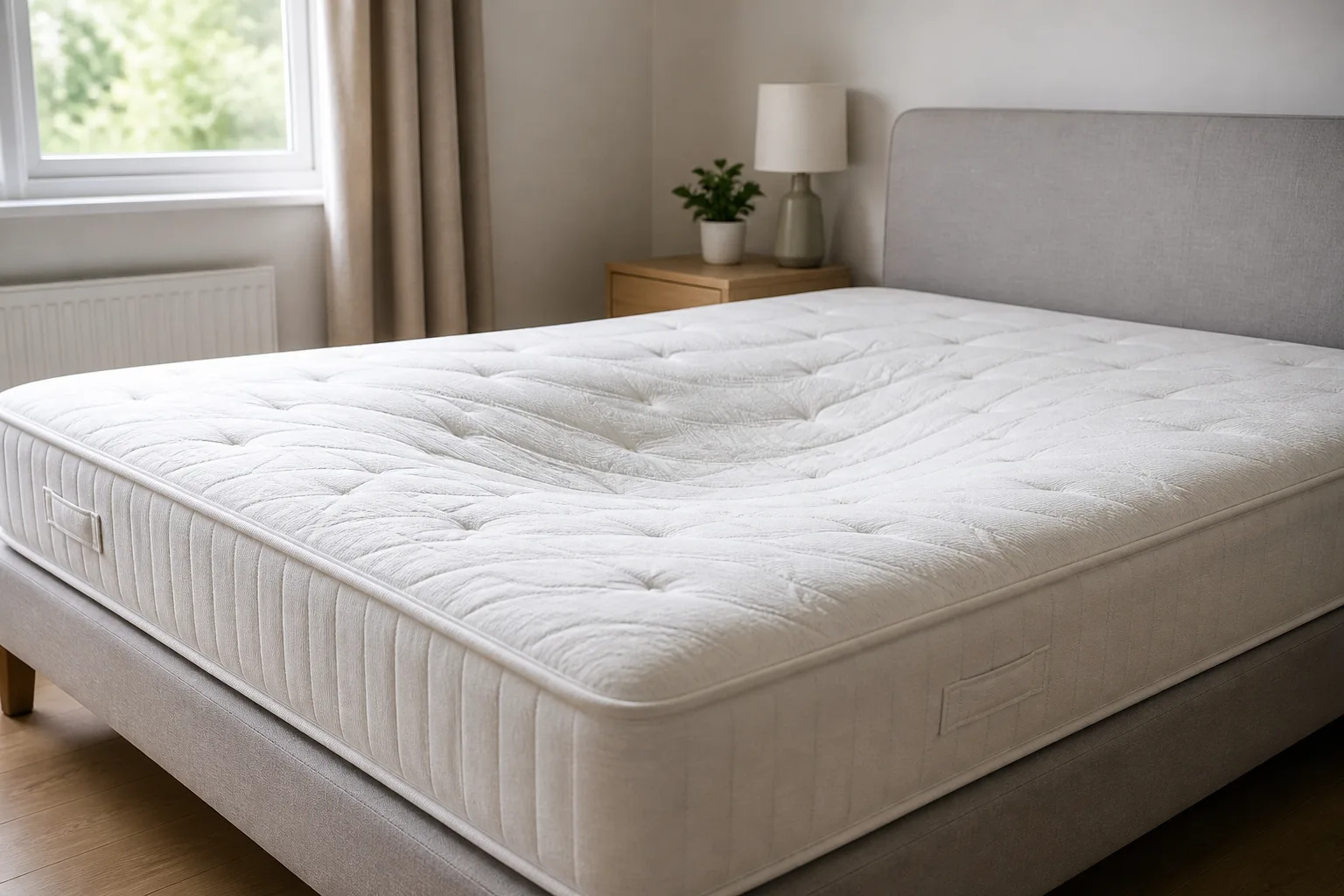
Some signs need no sleep diary. Strip the bed, remove the protector and look at the mattress in daylight. If it has permanent dips, raised ridges, burst seams or springs you can feel through the cover, the mattress has moved beyond normal wear.
Sign 4: Sagging stays after the bed is empty
Body impressions are normal to a point, especially in pillow-top, memory foam and natural-fibre mattresses. Permanent sagging is different. If the surface still dips heavily 30 minutes after you get up, support has changed.
Use a straight edge if you want to be precise. Lay a broom handle, metre rule or long spirit level across the mattress and look for the deepest gap. Many warranties only treat sagging as a fault once it passes a set depth, often around 2.5cm to 4cm depending on the brand and mattress type. That does not mean a 2cm dip is comfortable. It just means the warranty may not help.
Do not judge sagging while the mattress sits on a bad base. Slats that are too far apart, cracked or bowed can make a decent mattress look worse. A foam or hybrid mattress on wide slats may dip between them. If the base is the issue, replacing the mattress alone can repeat the same problem.
Sign 5: Lumps, ridges or springs disturb your sleep
Lumps usually mean filling has shifted, foam has softened unevenly or pocket springs are no longer sitting cleanly. Ridges often form where two sleepers use the same positions every night. Springs that creak, pop or press into your side are a stronger warning.
You can sometimes improve surface unevenness by rotating the mattress, using the correct side and checking the base. You cannot repair broken springs inside a modern mattress in a sensible, cost-effective way. Once springs are noisy or sharp enough to disturb sleep, replacement is the honest answer.
This is where cheap mattresses often show their real cost. A £220 double that lasts three years can be poorer value than a £650 hybrid that lasts seven, provided the better mattress suits you. Our piece on how much to spend on a mattress in the UK breaks down that cost-per-night logic in more detail.
Sleep Quality, Allergies and Heat Build-Up
Not every replacement sign is about support. Hygiene, temperature and sleep quality matter too. A mattress can be structurally acceptable and still be unpleasant to sleep on if it traps heat, smells musty or aggravates allergies.
Sign 6: You wake hot, itchy or blocked up more often
Older mattresses collect skin cells, dust, moisture and allergens over time. A good protector helps, but it does not make a mattress immortal. If you wake with a blocked nose, itchy eyes or worse allergy symptoms in bed, check the whole sleep environment: mattress, pillows, duvet, sheets, humidity and cleaning routine.
The NHS has practical advice on sleep and tiredness, but it is worth being specific at home. Wash bedding, replace old pillows, vacuum around the bed, air the mattress and use a washable protector. If symptoms improve away from your own bed and return when you sleep on it, the mattress may be part of the problem.
Heat is similar. A warm mattress is not automatically faulty. Memory foam, thick protectors, heavy duvets and small bedrooms can all trap warmth. But if your mattress has become noticeably softer, hammocks around you and holds heat more than it used to, the comfort layers may be breaking down.
Rule out bedding first
Before replacing the mattress for heat or allergies, check the cheaper layers:
- Pillows: old pillows can hold far more dust and sweat than people realise. Replacing them costs about £20-£80 a pair.
- Protector: a waterproof protector can make some mattresses hotter. Breathable cotton or Tencel protectors are usually £25-£60.
- Duvet: a 10.5 tog duvet in summer will make almost any mattress feel warm. Summer duvets are often £30-£100.
- Sheets: polyester blends can feel clammy. Cotton percale, linen or bamboo blends usually breathe better.
If those changes do not help and the mattress is old, stained or musty, replacement is sensible rather than indulgent.
Mattress Age, Warranty and What UK Retailers Actually Mean
Age is a clue, not a verdict. Some mattresses are finished after five years. Others are still good after ten. It depends on materials, sleeper weight, rotation, base quality, moisture, pets, children jumping on it, and whether it was a bargain open-coil model or a well-made pocket sprung, latex or hybrid mattress.
Sign 7: The mattress is past its useful life for its type
As a rough UK guide:
- Cheap open-coil mattress: often 3-5 years before support drops noticeably.
- Budget memory foam mattress: about 4-6 years, depending on foam density and heat exposure.
- Pocket sprung mattress: often 7-10 years if rotated and used on a good base.
- Hybrid mattress: around 6-9 years for many mainstream models.
- Latex mattress: often 8-12 years, sometimes longer, if it suits you and is well supported.
If you cannot remember when you bought the mattress, check the law label, receipt, email order history or retailer account. Brands such as Emma, Simba, IKEA, Dreams, Bensons for Beds and John Lewis usually keep order records if you bought online.
Warranty length is not the same as comfort life. A 10-year warranty normally covers manufacturing faults, not “I no longer sleep well on it”. Trial periods are different again. Many boxed mattresses offer 100-200 night trials, but check collection rules, mattress condition requirements and whether returns are free before ordering.
Replacement costs in the UK
For a standard UK double, realistic new-mattress prices look like this:
- Budget: about £180-£400 from IKEA, Argos, Amazon UK or sale ranges at Dreams and Bensons.
- Mid-range: about £450-£900 for many Emma, Simba, Otty, Silentnight, Sealy or John Lewis options.
- Premium: about £1,000-£2,000+ for higher-end pocket sprung, natural fibre, latex or specialist brands.
- Old mattress collection: usually about £20-£60 through councils or retailers, depending on area and service.
Specific examples change with sales, but the pattern is stable. IKEA often has doubles from roughly £199-£499. Emma and Simba sale prices commonly put double hybrids around £400-£900. John Lewis own-brand and Hypnos options can run from mid-hundreds to well over £1,000.
Do not buy only by discount percentage. Mattress retailers run permanent-looking sales, and a “50% off” banner tells you less than the final price, materials, trial terms and whether the feel suits your body.
What to Check Before You Buy a Replacement
Once the signs point towards replacement, slow down for one more pass. A new mattress should solve the actual problem, not just replace the old one with a more expensive mismatch.
Check the base and dimensions
Measure the bed base before ordering. UK mattress names are standard, but old frames, imported bed frames and handmade bases can vary. A UK double should be 135cm x 190cm, king 150cm x 200cm, and super king 180cm x 200cm. If the base is slightly odd, check tolerances before delivery.
Look at the base closely:
- Slat spacing: foam and hybrid mattresses often need closer slats or a solid platform.
- Centre support: doubles and kings need a stable centre rail or support legs.
- Damage: cracked slats, loose screws and bowed boards can ruin a new mattress.
- Ventilation: mattresses need airflow, especially foam and natural fillings.
Our guide to mattress foundations covers this in more depth. The short version: if the base is bad, fix it before judging or replacing the mattress.
Match firmness to sleeper, not marketing
Firmness labels are messy. One brand’s medium-firm can feel like another brand’s firm. Heavier sleepers often need more support, side sleepers usually need pressure relief at shoulders and hips, and front sleepers often need a flatter, firmer surface to stop the pelvis sinking.
If you are replacing because of back pain, do not assume the firmest mattress is best. Many people need support plus enough cushioning to keep the spine neutral. Our mattress for back pain guide goes deeper, but the useful shop-floor test is simple: can you lie in your normal position for 10 minutes without pressure building or your middle sinking?
Use the trial period properly
If you buy online, give the mattress a fair trial, but do not ignore obvious red flags. Most new mattresses need a few nights to settle and your body may need a week or two to adjust. Sharp pressure, numb arms, rolling together or clear back discomfort should not be dismissed for months.
Keep the old mattress until you are sure if you have space. If not, choose a retailer with clear return and collection terms. A cheap mattress with awkward return rules can become expensive fast.
The decision is usually clear once you collect the evidence. If the mattress is sagging, uncomfortable, old for its type, affecting sleep, aggravating heat or allergy issues, and not rescued by rotation, bedding changes or base checks, it is time to replace it. Those are the signs need new mattress buyers should trust more than a sale banner.
Frequently Asked Questions
How do I know if I need a new mattress? Look for repeated poor sleep, morning aches, visible sagging, lumps, noisy springs, allergy or heat issues, and a mattress that is old for its type.
How long should a mattress last? Many mattresses last 6-10 years, but cheap open-coil models may feel worn after 3-5 years while good latex or pocket sprung mattresses can last longer.
Is sagging enough reason to replace a mattress? Yes, if the sagging is permanent and affects support. Check the bed base first, because broken slats can make a mattress dip.
Can a topper fix an old mattress? A topper can soften a firm but supportive mattress. It will not properly fix deep sagging, broken springs or a mattress that has lost support.
How much should I spend on a replacement mattress in the UK? For a double, expect about £180-£400 for budget, £450-£900 for mid-range, and £1,000+ for premium options.
Should I replace my mattress if I have back pain? Maybe, but check medical causes, pillow height and bed base first. If pain is worse after sleeping and the mattress is sagging or unsupportive, replacement may help.